
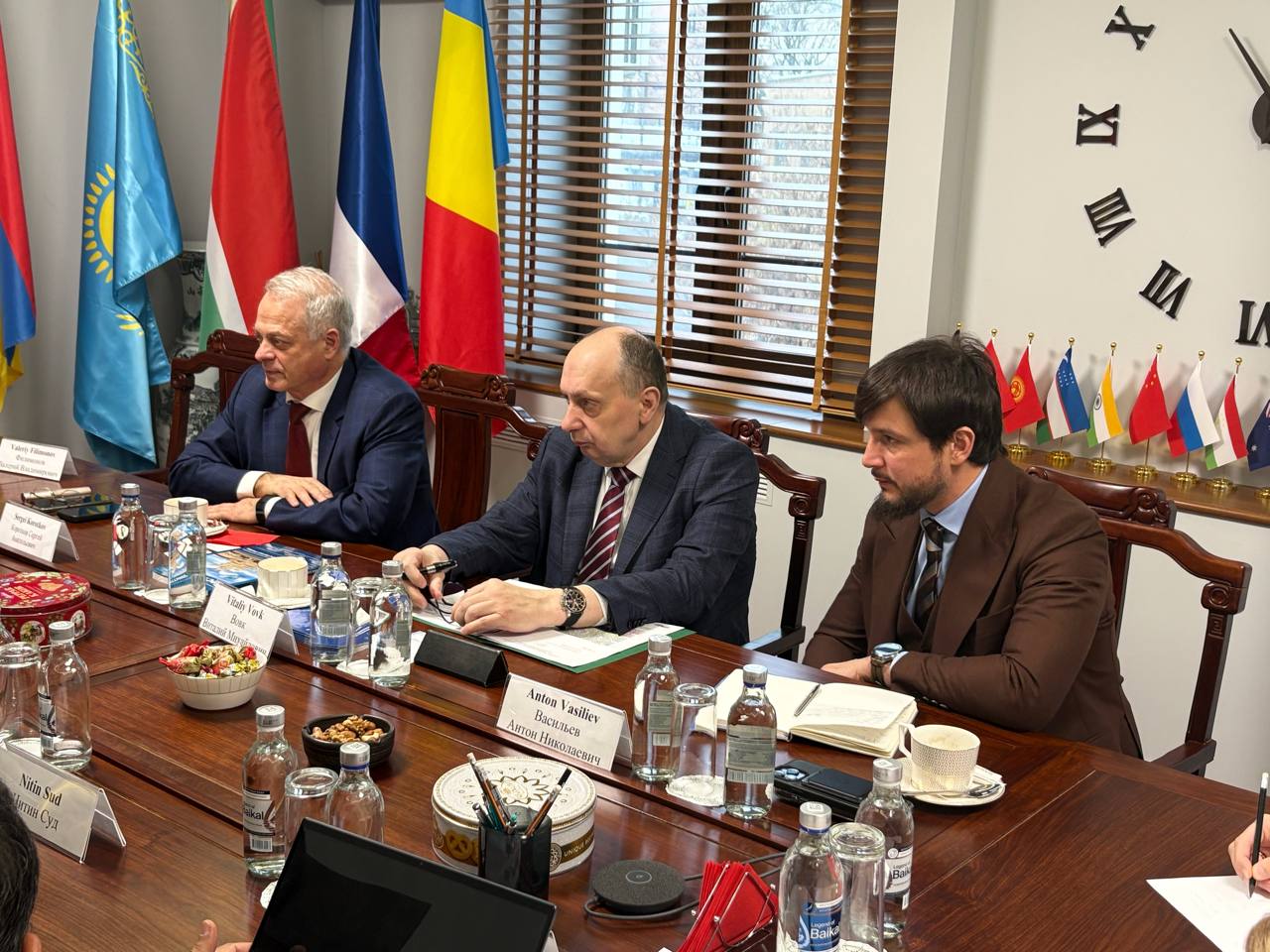
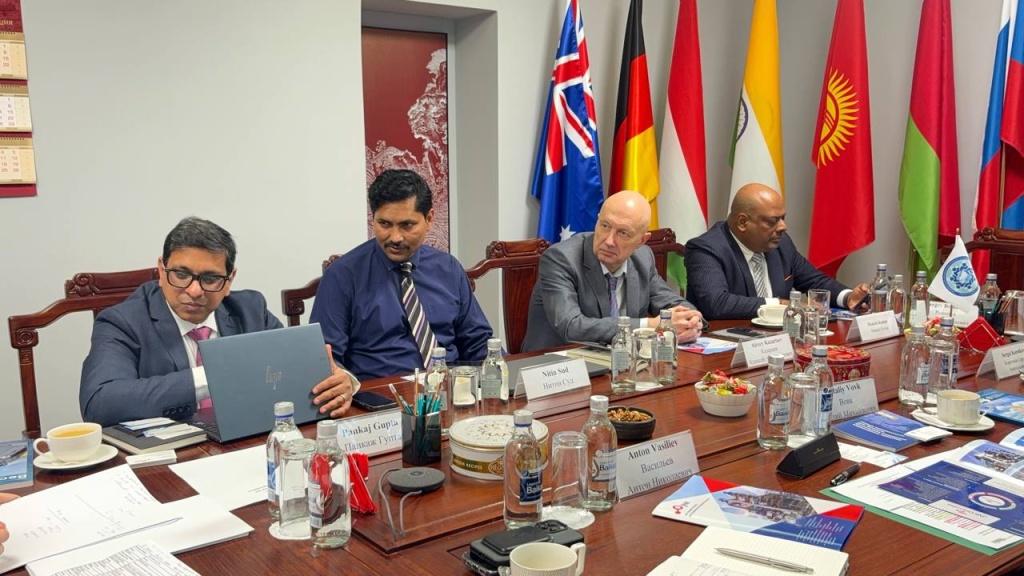
On March 3, the Eurasian Cooperation Financial and Business Association served as a platform for strategic dialogue between Indian businesses and key players in the EAEU’s oil, gas, and industrial sectors. The meeting was organized by Soltex Group, which has served as a business bridge between Russia and India for over 12 years. A key participant on the Indian side was JNK India Limited, a global leader in the production of oil refining equipment and process engineering.
The high level of representation confirmed the event’s significance for industrial cooperation. Negotiations with JNK India Limited, headed by Nitin Sudhi and Pankaj Gupta, were attended by Vitaly Vovk, Deputy Director of the Industrial Policy Department of the Eurasian Economic Commission; Manish Kumar, Deputy Chairman of the Management Board of the FBA EAC; Alexey Kazartsev, Head of the International Banking Committee of the FBA EAC and member of the Financial Services Group of the BRICS Business Council, PhD in Engineering; Sergey Korotkov, Advisor to the President of the FBA EAC; Anton Vasiliev, CEO of SPARTA LLC and member of the expert councils of State Duma committees; and Valerian Tochilo, Project Manager of Soltex Group.
Vitaly Vovk played a leading role in shaping the investment agenda, initiating the transition from one-time deliveries to long-term investment projects using corporate guarantees and rupee financing. The parties have developed a mechanism whereby the Russian company provides a corporate guarantee directly in India (for example, for an amount equivalent to $100 million in rupees) as an alternative to a standard bank guarantee. Under this guarantee, Indian partners are willing to provide up to 98% of the financing in rupees for industrial projects in Russia or joint ventures. Soltex, with 12 years of experience in India, provides discounting of funds through accounts in Indian branches of Russian banks. The Indian branches of VTB (favorable terms) and Sberbank (rates of 5-6%) can provide financing.
JNK India designs and manufactures process heaters, reformers, flare systems, and water treatment equipment, working with licensors UOP, Lummus, Technip, Haldor Topsoe, and EPC contractors Hyundai Engineering, SK E&C, and GS E&C. The company employs over 400 people. The Pune production facility is capable of producing large modules weighing up to 500 tons (projects for Dangote Refinery in Nigeria and PEMEX in Mexico). The technology portfolio includes distillation, evaporation, heat transfer, process heaters, cracking furnaces, and reformers (projects for Reliance Industries, BPCL, HPCL, and Assam Petrochemicals). In the field of industrial ecology, the company offers membrane wastewater treatment technologies, including Zero Liquid Discharge units. Its green technology portfolio includes the production of green hydrogen (participation in India’s National Hydrogen Mission), clean jet fuel, green chemicals, and carbon capture systems.
A separate set of discussions was devoted to the development of hydrogen infrastructure. The parties discussed the creation of a network of hydrogen refueling stations—both stationary combined and mobile units—including for the agro-industrial sector. The development of hydrogen technologies was discussed in conjunction with the existing natural gas vehicle fuel infrastructure as a foundation for the transition period. Participants analyzed the emerging hydrogen production landscape in Russia and the EAEU. The dilemma of choosing between natural gas-based gray hydrogen (Russia’s competitive advantage due to its low production cost) and green hydrogen from renewable energy sources (its high cost has temporarily halted active development) was examined in detail. Biohydrogen and related technologies were identified as a cross-cutting issue requiring inclusion in the final strategy.
An important topic of discussion was the specifics of working in the Union’s markets. Kazakhstan demonstrates an openness to targeted, pragmatic projects, while in Russia and Belarus, innovative agreements are more effective, where initial approval of technological solutions at the state or corporate level opens access to investment. Given the need for constant modernization of fixed assets, two models were identified: the rapid replacement of failed lines to maintain production continuity and comprehensive innovative programs through approved agreements. A key requirement for partners is the transition from simple supplies to a full-fledged service company model, prepared to integrate technologies and provide maintenance throughout the entire equipment lifecycle. This approach should be stated at the start of negotiations.
The parties agreed to continue the dialogue and develop a roadmap for implementing JNK India technologies at Russian industrial facilities using the proposed investment mechanisms and business models. Detailed project details, including specific figures and specifications, are possible after preliminary agreements with partners are finalized, including attracting investors from other countries.