
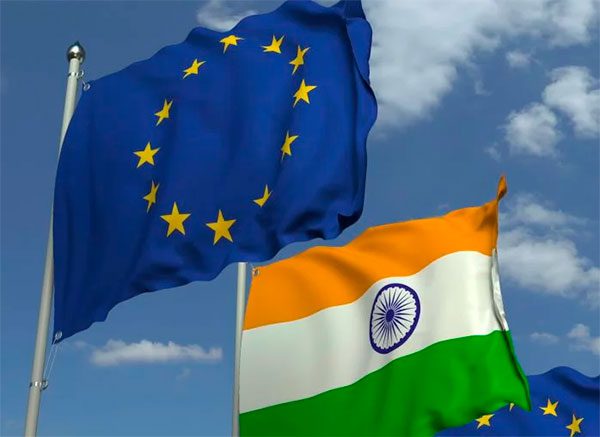
India and the EU have signed «the greatest trade deal of all time.» At least, that’s what Indian Prime Minister Narendra Modi and European Commission President Ursula von der Leyen called it. The agreement will also impact Russia, according to economists interviewed by Kommersant FM. The leaders of India and the EU announced the agreement today, after negotiations on the document lasted over 20 years. According to the agreement, India will eliminate tariffs on almost 97% of European exports, including chocolate, pasta, and olive oil. Tariffs on wine, automobiles, and precious metals will also be gradually reduced. Brussels estimates that this will save up to $4.75 billion annually.
The EU, in turn, will allocate €500 million to support India’s environmental projects and will also open access to its labor market. The conflict between the European Union and Donald Trump could have been a factor in achieving the deal, says Oleg Abelev, head of the analytical department at Rikom-Trust Investment Company: «For the EU, diversifying supply chains from China and finding a growing market with demographic potential is important. For India, it’s important to attract investment and technology, gain access for Indian specialists, and increase exports to the largest economic bloc. This isn’t so much a rift with Washington as it is a matter of different strategic approaches to global challenges. This is forcing the EU to more actively seek its own foothold in global politics and economics, without relying on the transatlantic alliance. And the agreement with India is only part of this strategy.
In the short and medium term, this agreement won’t replace trade with Washington, because the scale is incomparable. Trade and investment between the EU and the US is the foundation of the global economy, the largest bilateral relationship in the world. Furthermore, there are structural differences. India is primarily a sales market and a manufacturing alternative, while the US is both a market and a source of goods and capital for the EU. The EU may transfer some production—textiles, pharmaceuticals, auto parts, and green technologies—from China and other Asian countries to India, but this will not replace the US focus, but rather complement it.
India will face green and digital standards, which will increase the cost and complexity of interaction. Furthermore, India’s main financial and logistics flows will be tied to the West and Southeast Asia, which could complicate trade with Russia. It’s important to understand that the partners have different appeals. The EU offers technology, investment, and access to a market of 450 million consumers with relatively high incomes, while Russia offers cheap energy, weapons, and geopolitical balance in the UN. For India, this isn’t an «either-or» choice, but a parallel relationship.
The European auto industry has received the most favorable import tariff from India among all of New Delhi’s trading partners, Bloomberg reports. The tariff on imported cars will be reduced from 110% to 10%. Ursula von der Leyen noted that the EU has created a free trade zone with a market of 2 billion people. According to her, both sides will benefit from this deal. The rupee became the weakest Asian currency in 2025. According to media reports, Russia has accumulated a large amount of Indian currency, the withdrawal and use of which is limited. Against this backdrop, India’s regulator has even suggested that companies invest in government bonds.
However, Moscow may now have another use for its rupee reserves, notes Andrei Kolganov, head of the laboratory for comparative studies at the Faculty of Economics at Moscow State University: «In principle, the additional influx of European goods into India allows Russia to obtain European goods through Indian intermediaries. Just as we did through Turkey, Central Asian countries, and so on. India was not among the first countries through which we carried out so-called gray imports. But our trade volumes with India are quite significant. Perhaps some companies will genuinely want to engage in brokering, helping us circumvent sanctions and, naturally, profit from it.
I can’t yet predict the scale of such operations or the extent to which this will allow us to effectively utilize the accumulated Indian rupees paid for Russian oil. New Delhi will now have a new, stronger partner that will firmly insist on sanctions compliance. It’s difficult to predict the future of economic relations with Russia; it depends on the behavior of Indian companies and the government. For example, in China, some banks and companies closely integrated into the global market prefer to support the sanctions regime to varying degrees. Smaller companies, however, prefer to take the risk and engage in trade with Russian partners.
In August, Washington imposed an additional 25% tariff on Indian goods for continuing to import oil from Russia. The EU is also expected to impose additional sanctions. However, Stanislav Mitrakhovich, a senior research fellow at the Financial University and an energy expert, doubts that the Europeans will continue to strictly monitor Russian crude supplies amid tense relations with the US: «Russia currently supplies oil to India, where it is refined into petroleum products that are sold to various markets, both domestically (1.5 billion people) and for export, including to Europe.»
However, the 18th sanctions package includes a deferred measure, which took effect on January 21, 2026. It bans the import of petroleum products from third countries if they are made in Russia, meaning India and Turkey fall under this definition. But the EU is currently in a confrontation with America, the conflict with Russia isn’t even close to over, and now it still has to punish India and Turkey for having the audacity to buy Russian oil. Perhaps, after signing this document, they won’t harass the Indians. But there are no prospects for increasing oil supplies, since, according to the 18th sanctions package, they must slow down these supplies, at least until a new legal framework is created.
The official signing of the agreement between India and the EU will take place after legal review. According to Reuters sources, this could take five to six months.
Ulyana Gorelova